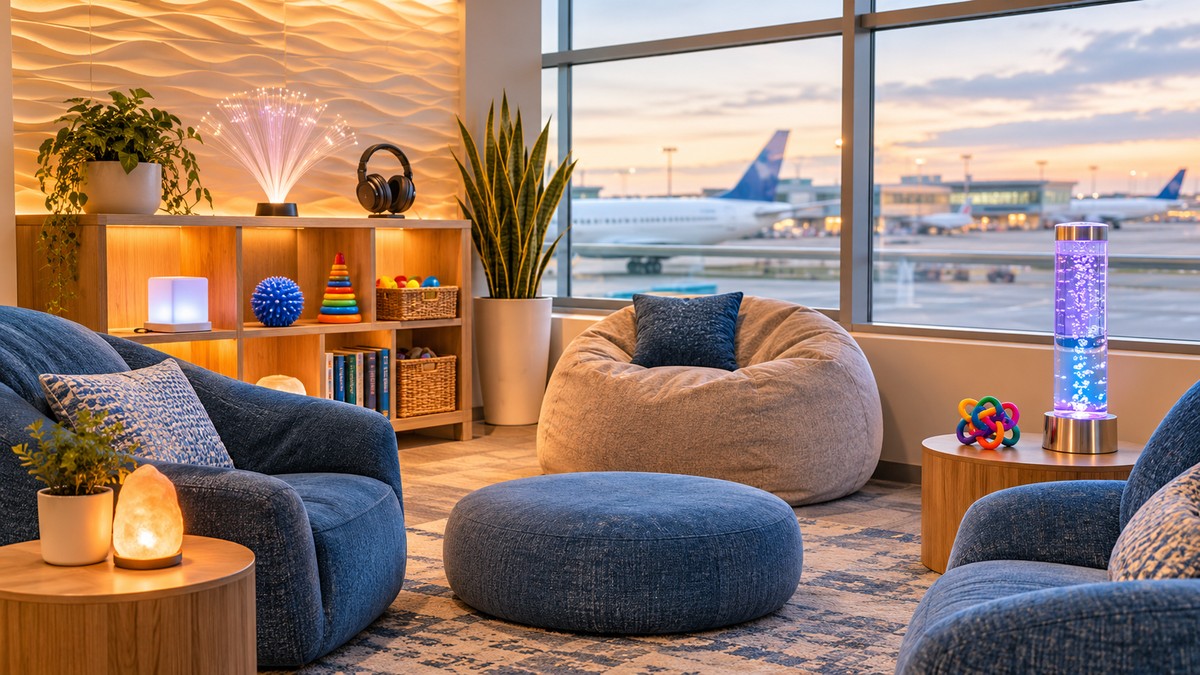
Airport Sensory Rooms & Quiet Spaces
Airports are loud, bright, crowded, and unpredictable — and for a lot of travelers, that combination can turn an exciting trip into a stressful one before it even begins. At Gathering Memories Travel, we believe every traveler deserves a calm place to land, whether that means a quiet corner to decompress, a dimly lit room to reset, or simply knowing where to go if things feel like too much.
The good news: more airports than ever are building airport sensory rooms specifically for this. Below, you'll find a complete, continuously updated guide to sensory rooms and quiet spaces at major airports around the world, plus practical answers to the questions travelers ask most.
At a Glance
14+ major airports now have a dedicated airport sensory room or quiet space
Most are free and require no advance booking
These spaces support travelers with autism, anxiety, PTSD, dementia, ADHD, chronic illness, and other sensory or accessibility needs
Always search "[airport code] sensory room" before flying — new rooms are added often
Quick Answer
Airport sensory rooms are free, dedicated quiet spaces now available at major airports worldwide, including Seattle-Tacoma, San Francisco, Pittsburgh, Orlando, Dubai, and Singapore. They support any traveler managing sensory overwhelm, anxiety, PTSD, dementia, ADHD, autism, or other visible and invisible disabilities. Most require no advance booking.
Who Uses Airport Sensory Rooms?
Anyone who finds airports overwhelming can use an airport sensory room — not just autistic travelers. These spaces are commonly used by people managing anxiety, PTSD, dementia, chronic illness, ADHD, and sensory processing differences. If crowded gates, bright lighting, or constant announcements make travel harder for you or someone you love, these rooms are built for you.
Which U.S. Airports Have Sensory Rooms?
The United States has airport sensory rooms at nine major hubs, listed below with their exact locations.
Airport | Code | Sensory Space | Location | Verified | Source |
Seattle-Tacoma | SEA | 2 sensory rooms | Underground A Station + Gate C3 | Nov 2026 | |
San Francisco | SFO | Sensory room | Harvey Milk Terminal 1, near Gate C2 | Nov 2026 | |
Pittsburgh | PIT | "Presley's Place" | Terminal | Nov 2026 | |
Orlando | MCO | "Annie's Space" | Terminal | Nov 2026 | |
Miami | MIA | Multi-sensory room | Terminal | Nov 2026 | |
Newark | EWR | Sensory rooms | Terminal A, pre- and post-security | Nov 2026 | |
Phoenix Sky Harbor | PHX | "Compassion Corner" | Terminal | Nov 2026 | |
Washington D.C. (Reagan National) | DCA | Disability services | Terminal | Nov 2026 | |
Los Angeles | LAX | Sensory needs resources | Terminal | Nov 2026 |
Which International Airports Have Sensory Rooms?
Five major international airports offer dedicated sensory rooms or assisted-travel lounges.
Airport | Code | Sensory Space | Location | Verified | Source |
Dubai | DXB | Assisted Travel Lounge | Calming lighting, tactile elements, dedicated decompression zone | Nov 2026 | |
Hong Kong | HKG | Sensory Corner | Terminal | Nov 2026 | |
Manchester | MAN | Assisted Travel Lounge | Terminals 2 and 3 | Nov 2026 | |
Dublin | DUB | Sensory room | Terminal | Nov 2026 | |
Singapore | SIN | Calm Room | Changi Airport | Nov 2026 |
Don't see your airport? Search "[your airport code] sensory room" before you fly — these spaces are added frequently.
Are Airport Lounges Helpful for Sensory Needs?
Yes, standard airport lounges can help sensory-sensitive travelers, though they aren't purpose-built for it. The main benefits are quieter seating away from gate noise, buffet-style food that gives you control over choices, and no loud boarding announcements. Noise levels and crowding still vary by location and time of day, so confirm before counting on it. For a space purpose-built for accessibility, the dedicated assisted-travel lounges listed above — Dubai and Manchester — are the better match.
How Do I Access an Airport Sensory Room?
Most airport sensory rooms are free and open to walk in, with no booking required. A few exceptions:
Seattle-Tacoma's rooms require a staff-provided access code
Assisted-travel lounges (like Dubai's) require advance arrangement through the airline's special-assistance team — these are not a walk-up option
Standard paid lounges require Priority Pass, a credit card with lounge access, or an airline day pass — present your card/app plus a same-day boarding pass at the door
What Should I Pack for an Overwhelming Flight?
Pack familiar snacks, noise-reducing headphones, a comfort item, and a visual schedule to make any flight easier, regardless of the reason travel feels hard.
Familiar grab-and-go snacks — reliable since food options vary a lot by airport
Noise-reducing headphones or earplugs for gate areas and boarding
A comfort item — a blanket, fidget tool, or anything that helps you reset
A visual schedule or written itinerary, with real photos of the terminal or lounge if available online
Frequently Asked Questions
Do I need to book an airport sensory room in advance?
No, most airport sensory rooms are free and walk-up. A few, like Seattle-Tacoma's, require a staff access code, and assisted-travel lounges like Dubai's need advance arrangement through the airline.
Are airport sensory rooms free to use?
Yes, nearly all named airport sensory rooms are free. Assisted-travel lounges vary by airline and airport.
What's the difference between a sensory room and an assisted-travel lounge?
A sensory room is a free, walk-up quiet space with calming features. An assisted-travel lounge is a broader airline service that typically requires advance arrangement.
Are airport sensory rooms only for autistic travelers?
No, airport sensory rooms support anyone with sensory sensitivities or accessibility needs, including travelers with anxiety, PTSD, dementia, chronic illness, ADHD, and autism.
How do I find out if my airport has a sensory room?
Search "[your airport code] sensory room" before every trip, even ones you've taken before, since new rooms are added often.
Planning a Trip That Actually Works for Your Family?
Every traveler's needs are different — a quieter route through security, a flight timed around medication, or an itinerary built around rest instead of back-to-back excursions. At Gathering Memories Travel, we design trips around your family's real needs, not a one-size-fits-all itinerary.
Book Your Complimentary Discovery Call →https://link.gatheringmemoriestravel.com/widget/bookings/gathering-memories-travel-call
Changelog: This guide was last reviewed and verified in November 2026. Airport sensory room information changes frequently — if you notice an update needed, let us know.